Saturday, May 15, 2010

Shooting from the field at the Impact game!

I had the opportunity last week to shoot a pro soccer game with a press pass. My wife was great in securing me the pass for the Montreal Impact game against the Toronto FC. My only issue was that the game was on the same day as the Montreal Canadians game 7 against Pittsburgh, but hey, its a chance in a life time for a new photographer like me.

My first thought was to gear...or lack there of. I was going to be able to spread the 7D's wings as this camera was said to be built for sports and wildlife photography. 8 fps, good AI servo focusing, 19 cross type AF points, various focusing modes, good high ISO handling. What I lack was lenses. I know sports photography requires some fast glass... f/2.8 or faster. Why? Well, you need to capture motion...and very fast motion. In order to freeze soccer, you need approx 1/400th shutter speed. And when you are shooting at night, the light just isn't there.

So I asked a good friend, Didier, who is ever so generous in loaning his photography gear, and borrowed a 70-200 f/2.8 L IS and a 300 f/4 L IS. I also brought along my XSI and a 28-75 f/2.8 for when they got close. Soccer is played on a big field, so you need long lenses. Ever watch a football game and see all these photographers on the sidelines with these giant lenses that look like bazookas? They need those if they want to get up close and emotional shots. But one of those is about $8,000, so they normally have their companies pay for them.

Emotion is what sports is about. Just as with any other people photography. You want to capture faces, you want to capture emotions, triumph, struggle. You don't want the back of someone's head (although that can work for some shots). Heh, look at me, thinking I'm a pro. This was my first time shooting pro sports, and I have minimal sports shooting experience. On to the game!

I show up early (I'm anal about that) and get my press pass. My wife was meeting some friends and her dad, so we went our seperate ways. Having the pass was pretty neat as I was able to skip over the lineups to get in. When I got near the field, the security guard opened the gate to let me on the field. "Cool! I'm a superstar!". Then reality hit...where the hell do I go? Its a big field, lots of people. And yet, there were no photographers there (the bane of being early).

The Impact staff on the field where great. The Field Coordinator gave me the ins and outs of what I can and can't do. I was basically limited to one of four spaces between the corner kick line and the goal post. No sideline access, as this is reserved for their staff photographer. Hey, I'm just happy being there.

So I start taking out my gear. I mount the 70-200 on my 7D and attach the monopod. I take out the XSI and mount the 300. I prepare the 28-75 for quick access, put the lens hood on, and ready it in case I need to grab it. I set the empty memories cards in the bag for easy access. Then the big guys show... the Associated Press and the Reuters photographers. They walk by me, giving me a little glance as I guess I'm the new competition. But man oh man, did I have lens envy. They each had these ginormous lenses slung over their shoulder, shooting with 1D Mk IIIs (2 of them) and 70-200's on their second body. When you tally up the cost of the two bodies and two lenses, you hit just over the $20k mark. This is why they say sports photography is the most expensive type of photography.

The game started, I shot away. I had a 1.4x extender on the 300mm lens which was mounted on the XSI, which made it more like a 420mm on my 7D (which also has a crop factor of 1.4). However, it cuts 1 stop of light, so the f/4 is not an f/5.6. I was only able to get a shutter of 1/100 at ISO 800, which was useless. So I quickly switched on the 28-75 for the really close shots (which didn't happen).

I spent most of the game shooting with the 70-200 on the 7D. The game is so fast, its insane. One moment, you are zooming in on the winger running down the line and within an instant, the ball is flying to the goalie. You have to know the game and anticipate shots. I would sometimes wait with my camera pointed at the goalie to capture a save or a goal. I probably missed a few shots in doing so, but I did manage to get a diving save (which the AP and Reuters guys, sitting opposite me, had a great shot of the goal post and the goalie's butt haha!)


I would assume that hockey is the same style of shooting, but on a smaller surface. The gameplay is fast and hectic and can change directions at anytime. Basketball is on a small court, but a different shooting style as one team is on offense, one on defense. Sure, that can change quickly, but generally, you can get in a mindset for a certain shot and wait for it. With 80+ points in a game, you have many opportunities for layups and dunks. Football would be a mix of soccer and basketball... the field is huge, but the play is a little more straight forward. Knowing each sport is key though. If you are shooting an NFL game and its 3rd and 1, I wouldn't really focus on the receivers as chances are its a run play.

All in all, I had an amazing time. I would do it again in a heartbeat. You can view the set of 50ish images on my flickr and here are a few of my faves from the game. I have plenty more to say on the game, but I feel I've gone on long enough

In closing, I have to say that I chose the correct place to shoot from as I could see the TV sets in the boxes not too far and was able to zoom in to watch replays of the Habs game! haha :)


Wednesday, May 5, 2010

Never forget

I heard a quote not long ago that rings true with me: "Photography is about capturing life at 1/100 shutter speed" (I think thats going to be my blog's subtitle!). Sounds geeky, I know, but it is very true. One of the reasons I love candid portrait photography is that you can capture a moment in time forever, and you need to be quick, else its gone.

I've been taking photos at the Remembrance Day memorials for the last 2 years. My first year in 2008, I went to capture an event. After taking pictures from the outside in, I made my way inside the tent they had setup for the veterans and managed to get up close with some of them. I was mezmorized by these heroes. When I went back to the memorial in 2009, I went with a different focus, one to capture the people and not the event. I managed to wiggle my way up with the press photographers and managed to get up close with the people. I'm very proud of these photographs, I feel they are my best work to date as they capture the people and the emotion of the day.

You can view the full set (42 images) up on my flickr, here are the few images that I particularly like from the day:


Wednesday, April 28, 2010

Go Canada Go!

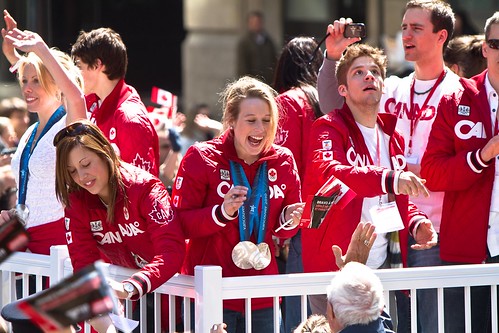
I'm a proud french canadian. So when I was told that our amazing olympic and paralympic athletes were coming to downtown Montreal for a parade, I made sure to book an extra long lunch, packed up my new 7D and headed out with a friend to capture the event.

The parade was from 11:30am to 1:30pm and went through most of the downtown core. We got to the end of the parade around 11:15am to ensure we have a decent vantage point, up on some stairs, above the crowd.

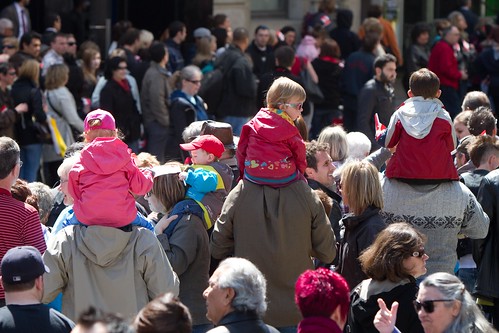
Ste-Catherine street was packed, office workers, families, kids...everyone was out waiting to cheer on their favorite athlete. Kids got one of the better seats in the house, sitting on top of their parents shoulders, patiently waiting. The first few people to parade down were the local radio stations and other event sponsors (got to love marketing), followed by some people who were simply trying to get the crowd excited. But trust me, Montreal rarely needs encouragement to be loud.

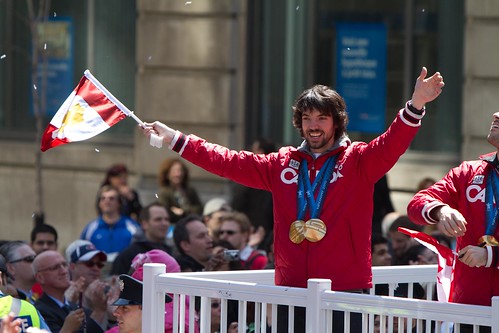
The first few athletes were carrying flags. They were right close to the crowd, and taking the time to give high fives and sign autographs. I managed to find John Montgomery (gold, skeleton) being his typical excited and happy self. All he was missing was a pitcher of beer in his hands.

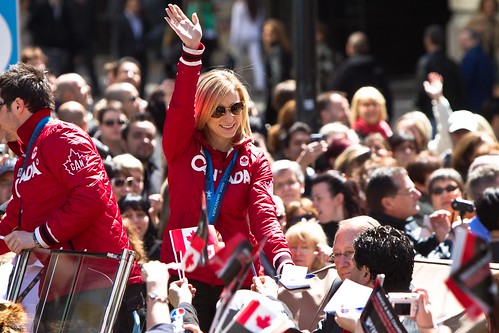
Joannie Rochette was an inspiration to all during the olympics. Having lost her mother but a few days before she performed, and still managing to go through it all and bring home a bronze was just amazing. She was the first to come through behind the flag bearers, in a car with the mayor of Montreal

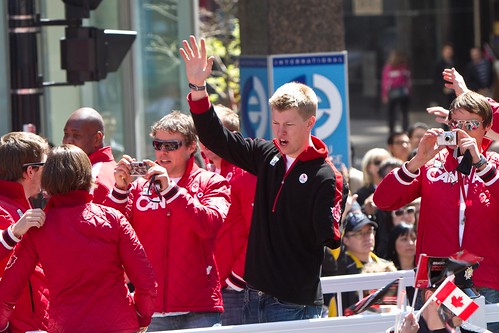
I There are just about 50 photos up on my flickr set , I won't go through them all here. The athletes were really gracious, taking the time to let people touch their medals, talk with some people, pose for pictures. While the crowds were so loud that I couldn't hear a friend of mine calling my name from 5 feet in front of me, I'm not sure who was more excited, us or the athletes

Here are a few images from the parade:


Wednesday, April 21, 2010

New gear!

It is known in the photography world that between the camera body and the lenses, the lenses are the more important components. Even to the point of buying a cheaper body if this will allow you to buy better lenses.

But once in a while, you find yourself lagging behind in technology. At the rate that the big boys (Canon and Nikon) pump out new bodies, within a few years, you are behind the curb. I bought my Canon XSI in summer 2008 while it was the newest of the Canon Rebel line and out at the same time as the Canon 40D, their top "pro-sumer" body. From 2008 to spring 2010, Canon upped their Rebel line not just once with the T1i, but a second time with the T2i. Adding in higher ISO, movie modes and so on. They have upped their 40D to a 50D, they came out with the uber awesome full frame 5D MkII and also started with a new top of the line crop sensor camera, the 7D.

I bought the camera not knowing much. It met my needs at the time...it was a dSLR, it fit the 2 Canon lenses I had found in my mom's camera bag, and it was the cheapest. But now that I'm getting into photography and understanding light and how your camera records it, I was in need of an upgrade. The main drivers were higher ISO performance, more weather resistant body and faster shooting speeds.

Cost of a new body ranged from $600 for a used 40D all the way up to $3200 for the 5D MkII, with the others falling in order from the T1i (900), 50D (1200), 5D (1500) and then the 7D (1800).

Decisions, decisions. I work hard for my money, so when I decide to spend it, I want to make sure I am spending in on what is best for me. Here is a bit of my decision thought process:

The flagship model for Canon is the 1D series. But this comes with a price tag of over $5000. Not in my budget and actually not in my current needs. The top of what I can get would be the 5D MkII. However, this would be a full frame camera and my XSI is a crop sensor camera. In changing sensor types, my beloved 10-22mm wide angle lens would no longer work as it can only be mounted on a crop sensor camera (it has the EF-S designation). So not only would I be dishing out $3000 on a new camera, I would need to either replace this lens with the full frame equivalent, the 16-35 which is approx $1500, or not have a wide angle lens. So I'll have to wait longer for the switch to full frame.

I decided to stick with crop sensor cameras and my choices were now the T1i, 50D or 7D.

The debate between the 50D and the T1i is the same I first had in 2008 when chosing between the 40D and the XSI. Back then, I went with the XSI and after 6 months I wished I had the 40D. Not that the Rebel isn't a good camera, as I've loved having it, when you handle a higher end camera, you can easily tell why they are the "entry level" line. The Rebel camera is plastic, small, shoots slower and has some important functions in the menu instead of easily accessible buttons. The xxD line is magnesium body, bigger and shoots usually twice as fast (6.3 fps vs 3.4 fps). Without going into more details, I decided to not repeat the past and go with a higher end line of cameras.

So that left me to decide between the 50D and the 7D. What are the differences? The 7D is fully weather sealed, it shoots 8 fps and has a new autofocussing system (first Canon camera with it), dual processors, a 100% magnification view finder.... basically a bunch of improvements. The 50D is a great camera and I wouldn't hesitate buying it, but its already a little over a year old and will be replaced by the 60D in a few months.

So while I normally go for the cheaper alternative, I decided to go with the new tech and pay more money.

I've had the camera for a few weeks and I must say, it is flippin' awesome. Just for the ease of access of the menu and its button layout alone. The high ISO (I've shot up to 6400) is great, although still not as nice as the 5D MkII. I've done some concert shots at 2000 ISO using a 50mm 1.8 and had great results. I'll have a chance to try the 8 fps along with the new auto focusing system when I actually get to shoot a Montreal Impact soccer game on March 12th. The reviews called this camera the best crop sensor camera out there and say that its made for sports and fast action. I guess we'll see.

Where to go from here? I should be good for 3-4 years with this camera, maybe more. My next step up is full frame. But before getting there, I'll start the journey of getting better lenses so that when I am ready for the switch, I'll have all the lenses to go with the new body. Maybe by that time, the 5D MkIV will be out. I'm also going to be looking at strobes and all the gear that goes with them.

Here are some low light photos from a concert. You can view the full set on my flickr.


These were mostly shot at ISO 2000-3200, f/1.8 - f/2.8 and with a shutter of around 1/30 - 1/80.


Monday, April 12, 2010

Urban art walk

One of my favorite subjects to photograph in a city is graffiti. I'm not talking about tags that people throw out anywhere, but actual art that people have taken the time to create. I have taken photos of graffiti that are no longer there, and others that were commissioned by actual shop owners.

A few weeks ago, I walked down Duluth street from the Lafontaine Park down to about St-Laurent street. Its a great little street to walk down, not much in terms of shops, but it has alot of character. I found some interesting art up on their walls, doors and garages

You can view my full graffiti set on flickr, but here are some highlights from my little Duluth street walk


Face on wall